The UGV Connectivity Problem: Why 50,000 Ground Robots Need a Better Link Than Starlink
Ukraine plans to procure 50,000 unmanned ground vehicles in 2026. Nearly all of them run on Starlink. That is a capability. It is also a dependency — and one that European armies cannot replicate at all.

Ukraine's Ministry of Defense has set an unusually specific goal for 2026: transfer all frontline logistics to unmanned ground vehicles and procure more than fifty thousand of them within the year. It is one of the largest single-year robotic procurement targets in military history — and it is already underway.
The vehicles themselves are not the hard part. The hard part is keeping them connected.
The Starlink Default
Walk up to almost any Ukrainian UGV operating in the field today and you will find the same thing mounted somewhere on the platform: a Starlink terminal. Estimates from Ukrainian operators and defense industry sources put the figure at roughly 99 percent of deployed ground robots. The reason is straightforward — Starlink works, it is available, and it is already in wide use across Ukrainian units. When the armed forces needed to push unmanned logistics vehicles into contested terrain, they reached for the same connectivity solution that had proven itself everywhere else.
The result is a de facto standard that nobody designed and nobody formally approved. Starlink became the default UGV communications layer by force of circumstance.
This created a capability. It also created a dependency — and a set of constraints that are becoming increasingly difficult to ignore as the fleet scales toward five-figure numbers.
Why the Starlink Default Doesn't Scale
The problems with a Starlink-dominant UGV communications architecture fall into three categories, each with different implications for Ukraine's partners and for the long-term viability of the model.
The regulatory barrier. Starlink's availability is governed by SpaceX's operational licenses, country-level agreements, and export controls. EU member states operate under a different regulatory environment. Several NATO allies have been unable to integrate Starlink terminals into their military procurement programs due to certification requirements, sovereignty concerns about dependence on a single American commercial provider, and specific national regulations around frequency allocation and terminal authorization. For European armies looking at UGV programs — and the interest is real, given what Ukraine has demonstrated — the Ukrainian model is not directly transferable. They cannot simply replicate the Starlink-on-every-robot approach. They need an alternative. Right now, credible alternatives for this specific application are thin.
The duration mismatch. This is the less-discussed constraint, and in many ways the more structurally difficult one. Drone relay systems — using a UAV to carry a communications payload above the terrain and extend radio range — are a reasonable interim solution for some tactical problems. They are not a workable solution for UGV logistics. The reason is simple: a ground vehicle running a logistics route can be in motion for six, eight, twelve hours at a stretch. The rotary-wing drones typically used for relay missions have endurance measured in twenty to forty minutes. Fixed-wing endurance is better but still measured in hours, not shifts. Maintaining continuous communications coverage over a multi-hour UGV mission via drone relay requires either a rotation schedule of aircraft that multiplies cost and complexity by an order of magnitude, or accepting gaps in coverage — which, for an unmanned vehicle operating in contested terrain without a human driver, is not a gap. It is a loss of control.
The drone relay workaround solves the terrain problem. It does not solve the endurance problem.
The control-link dependency. A UGV operating beyond line of sight requires a continuous, low-latency communications link for command and control. This is not a logistics optimization — it is a safety-critical function. When the link drops, the vehicle either stops, continues autonomously on its last instruction, or behaves in ways that were not intended. At scale, across fifty thousand vehicles operating in a contested electromagnetic environment, link reliability becomes a first-order operational requirement. Routing everything through a single commercial satellite constellation — one that has already experienced a global outage that left U.S. Navy unmanned surface vessels adrift — is an architecture that assumes the link will always be available. That assumption has been tested repeatedly, and it has not always held.
What the Problem Actually Requires
Stated precisely: a UGV communications architecture needs elevated relay coverage that is persistent across multi-hour mission windows, does not depend on a foreign commercial provider, and can be deployed close enough to the operating area to maintain low-latency command-and-control links.
"Elevated" is not optional. Ground-based radio range is constrained by terrain and earth's curvature. A vehicle operating several kilometers from its control node across broken ground cannot rely on surface-level propagation. The payload has to be at altitude.
"Persistent" is the operative word. Not elevated for twenty minutes while a drone is on station. Elevated continuously — for the duration of the mission, across the mission cycle, through weather, day and night. The communications layer cannot have a shorter operational lifespan than the vehicle it is supporting.
"Independent" matters for the export case. European customers will not build national UGV programs on top of connectivity infrastructure they cannot control, cannot certify under their own regulatory frameworks, and cannot operate in contested environments where a commercial provider's service agreement may not include battlefield continuity guarantees.
The Platform That Fits

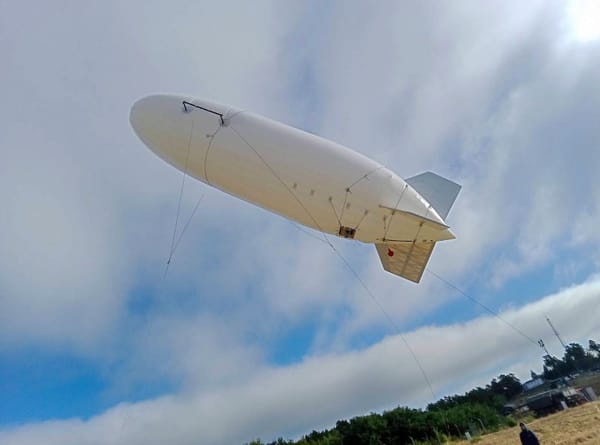
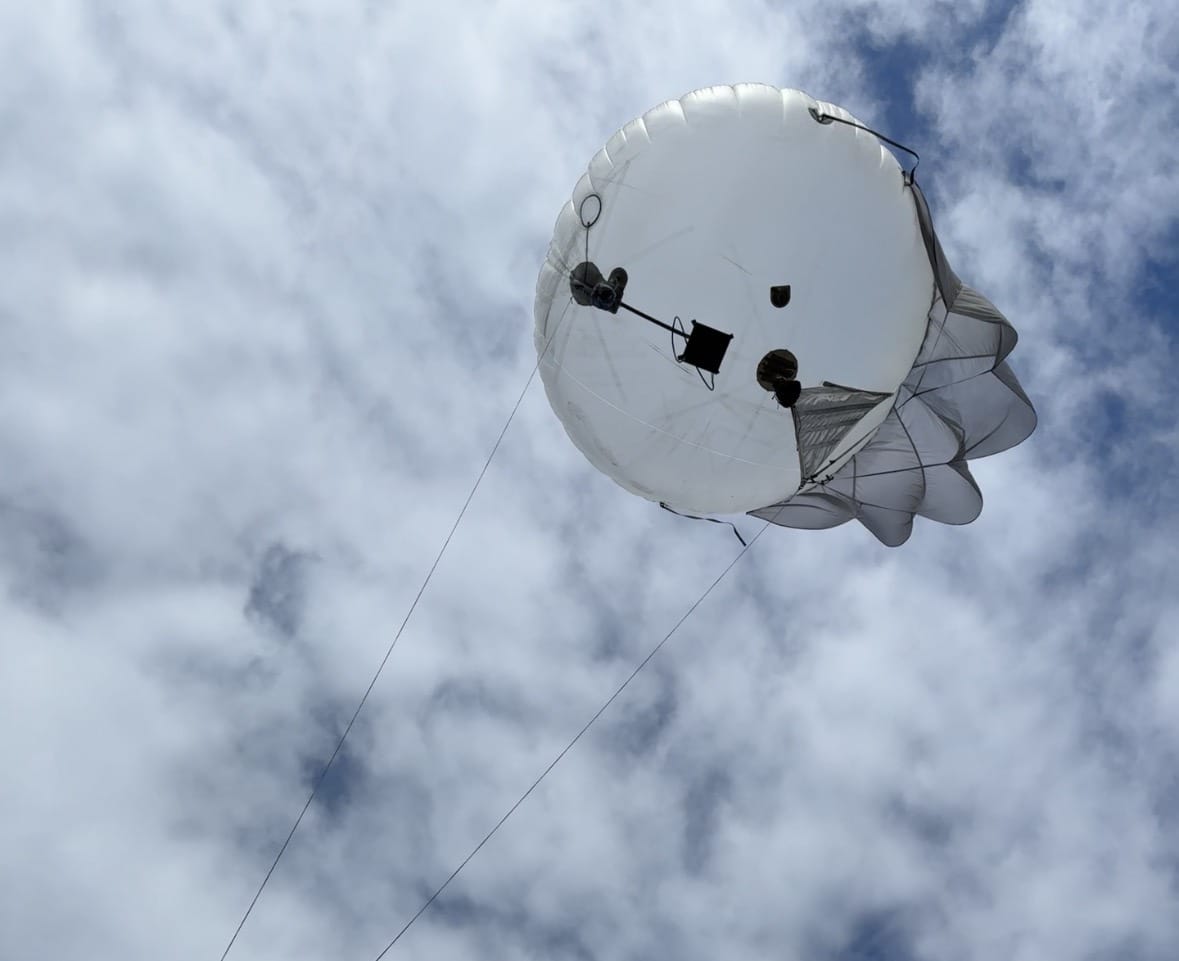
Tethered aerostats do not require orbital infrastructure. They lift a communications payload — a tactical data radio, a mesh network node, whatever the mission requires — to several hundred meters of altitude, where it achieves full specified range across all directions simultaneously. Power and data travel through the tether. The platform holds position through wind and weather. It does not rotate. It does not need fuel. It does not need a crew on a six-hour shift cycle.
At 500 meters of altitude, a relay payload achieves geometric line-of-sight across a radius sufficient to cover a brigade-sized logistics sector. A UGV on a twelve-hour route stays within that coverage envelope for the full mission. When the next mission begins, the aerostat is still up.
This is not a theoretical capability. Aerostats were used during Ukraine's Kursk incursion to extend radio coverage to units that had lost Starlink access after crossing the border. The operational logic is identical: a platform that stays elevated regardless of what is happening at the satellite layer, the regulatory layer, or the electromagnetic layer.
For European armies, the case is more direct. An aerostat relay uses standard tactical radios — whatever the national standard happens to be. It does not require a commercial connectivity agreement with a foreign provider. It does not require regulatory approval for a satellite terminal. It requires helium, a tether, and a platform capable of carrying the payload. The platform can be domestic. The radio can be domestic. The data link stays within the national military network.
The Architecture Question
The fifty-thousand-unit procurement target is a statement about scale. At that scale, the communications infrastructure is not a secondary concern — it is the enabling constraint. You can build the vehicles. If you cannot keep them connected across multi-hour missions in a contested electromagnetic environment, you have a fleet of expensive objects that stop responding when the link drops.
The Ukrainian experience has produced a clear set of requirements: elevated, persistent, controllable, independent. Starlink answered the first requirement cheaply and immediately. The other three are harder to satisfy with satellite connectivity alone — and they become harder to ignore as the fleet grows.
Ground robots are changing military logistics. The connectivity architecture that supports them needs to be designed with the same rigor applied to the vehicles themselves.
The platforms capable of meeting that requirement already exist and are already operating in the field. The question is whether they get integrated into UGV programs before scale exposes the gaps, or after.
Aerobavovna designs and manufactures military-grade aerostat systems for elevated connectivity — communications relay, ELINT, and antenna elevation — deployed with the Armed Forces of Ukraine.