The payload RF spectrum — what we lift on our aerostats

Key takeaways
TL;DR. Aerobavovna is the aerostat platform; the comms payloads come from their makers — Silvus, Persistent Systems, TrellisWare and DTC on the MANET side, Radionor's phased-array link, and L3Harris Falcon III. Lifting these radios hundreds of metres up doesn't change the band — it extends the range.
- MANET radios flown as payloads: Silvus, Persistent Systems, TrellisWare, DTC
- Plus Radionor phased-array link, L3Harris Falcon III; Ukrainian video: Teletactica, Sine
- Aerobavovna = platform only; radios are the manufacturers'
- Elevating the antenna keeps the band, extends line-of-sight range (bands per 2025 datasheets)
I put this together for internal use — a quick reference for which comms payload sits in which band when we're integrating it onto an aerostat. It turned out useful enough that I figured I'd share it.
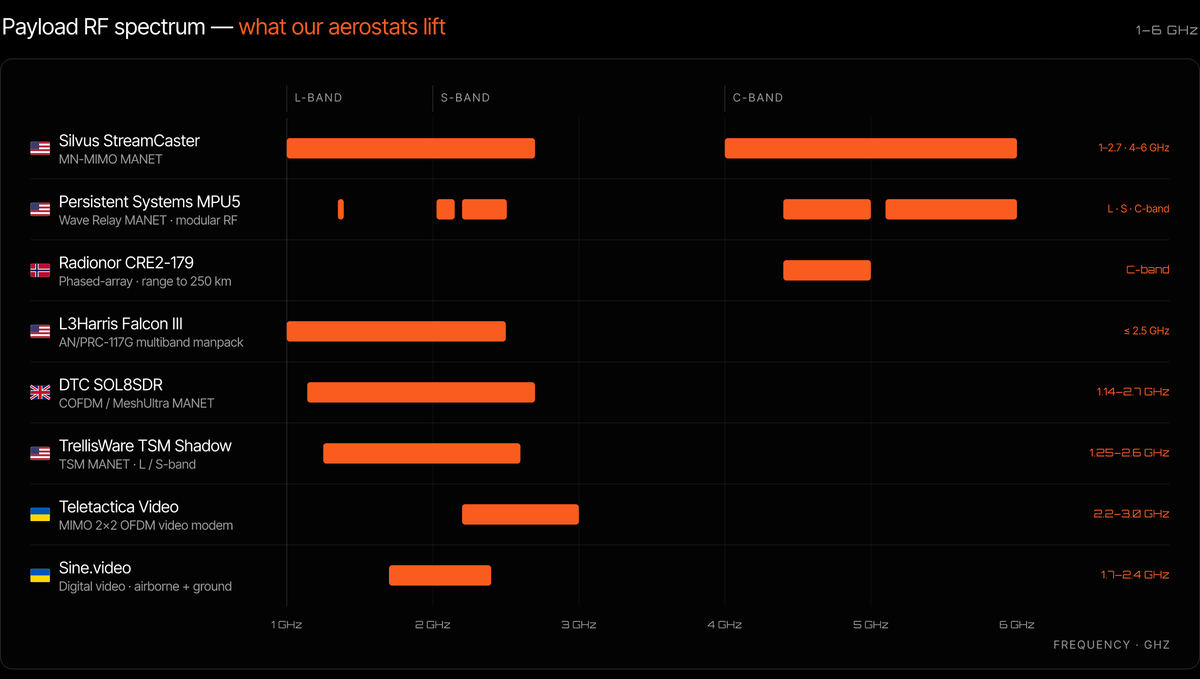
Every system in the chart is something we actually fly as a payload. Aerobavovna is the platform; the radios come from their manufacturers — Silvus, Persistent Systems, TrellisWare and DTC on the MANET side, Radionor's phased-array link, L3Harris Falcon III, and Ukrainian video systems from Teletactica and Sine.
Why it matters: lifting these radios on an aerostat puts the antenna hundreds of metres up. The band doesn't change — the range does. A ground-level line-of-sight link becomes a much longer one.
Bands per manufacturer datasheets (2025). Modular-RF radios (Persistent, DTC) show selectable front-ends.
FAQ
Which radios can an Aerobavovna aerostat carry?
MANET radios from Silvus, Persistent Systems, TrellisWare and DTC, Radionor's phased-array link, L3Harris Falcon III, and Ukrainian video systems from Teletactica and Sine.
Does lifting a radio on an aerostat change its frequency band?
No — the band stays the same. Elevating the antenna hundreds of metres extends the line-of-sight range.