The Second Link: What Ukraine's Ground Robots Use When Starlink Isn't Enough
Ukraine has contracted 22,000 ground robots for 2026 and is heading toward fifty thousand. Almost all run Starlink — that part is known. Our research looked at what sits underneath it.

Key takeaways
TL;DR. Ukraine has contracted 22,000+ ground robots for 2026 and is heading toward 50,000. Roughly 99% run on Starlink — yet a review of the codified logistics fleet names Starlink on only about 7 in 10 configurations. In a contested EW environment a single satellite link is a single point of failure, and a fleet this size needs a second link underneath it.
- 22,000+ UGVs contracted for 2026 (≈2× all of 2025); target toward 50,000
- 67 UGV types codified since January
- June: 16,600+ logistics / evacuation missions (+122% since January)
- ~99% carry Starlink (operator estimate); codified fleet names it on ~7 in 10 configs
Ukraine's defence procurement agency has contracted more than 22,000 ground robots for 2026 — already almost double the total for all of 2025, with contracting still open and the year's target set far higher, toward fifty thousand. Sixty-seven new UGV types have been codified and cleared for service since January. In June alone, ground robots ran more than 16,600 logistics and evacuation missions on the front — up 122% since January.
At that scale, the vehicle is no longer the hard part. The link is. We argued this at length in The UGV Connectivity Problem. This piece is about what our research found underneath the headline.
The part everyone already knows
Almost every Ukrainian UGV in the field carries a Starlink terminal — operators put the figure near 99%. It works, it is available, it was already everywhere. Starlink became the default nobody formally chose. That story is well told.
The more useful question is what sits alongside it. In a contested electromagnetic environment, a single satellite link is a single point of failure — and a fleet heading toward five figures cannot rest on one commercial constellation that has already gone dark globally at least once.
What our research shows underneath
We went through the published communications specification of the codified logistics fleet — every configuration, tracked and wheeled. Starlink is named on roughly seven in ten.
The second link is not another satellite service. It is ELRS — ExpressLRS, the open-source long-range control protocol the drone world already runs on — present on more than half the fleet. It has effectively become the default control link, displacing the older TBS Crossfire that now lingers mainly on legacy configurations. LTE is third, on close to half.
It is worth being precise about why. ELRS did not win because it survives jamming — it is a line-of-sight radio link like any other. It won because it is cheap, ubiquitous, open, and long-range, the same link that already flies millions of Ukrainian drones. The one genuinely un-jammable option in the fleet is optical fibre, spooled straight off the robot exactly as on an FPV drone; it appears on the Gnom and MOROZ classes and is spreading, but it is short-tethered and niche. SILVUS mesh turns up on the heaviest platforms. The picture is simpler than a layered-defence diagram: Starlink for reach, ELRS for control, fibre where jamming makes radio impossible.
Why the alternatives still need altitude
Here is the catch the spec sheets do not print. Starlink reaches over the horizon; ELRS, SILVUS and the rest do not. Their range is line-of-sight — and a ground robot several kilometres out across broken terrain, behind a treeline or a ridge, falls out of that line quickly. The alternative to satellite is tactical radio, and tactical radio only delivers its rated range when the antenna is high.
That is the same conclusion the fleet keeps arriving at from the other direction: the control link still has to be elevated — and elevated for the whole mission, not for the twenty minutes a relay drone stays airborne. A persistent antenna held at altitude over the logistics sector is what turns the second link into a link that actually reaches the robot.
What that looks like in practice
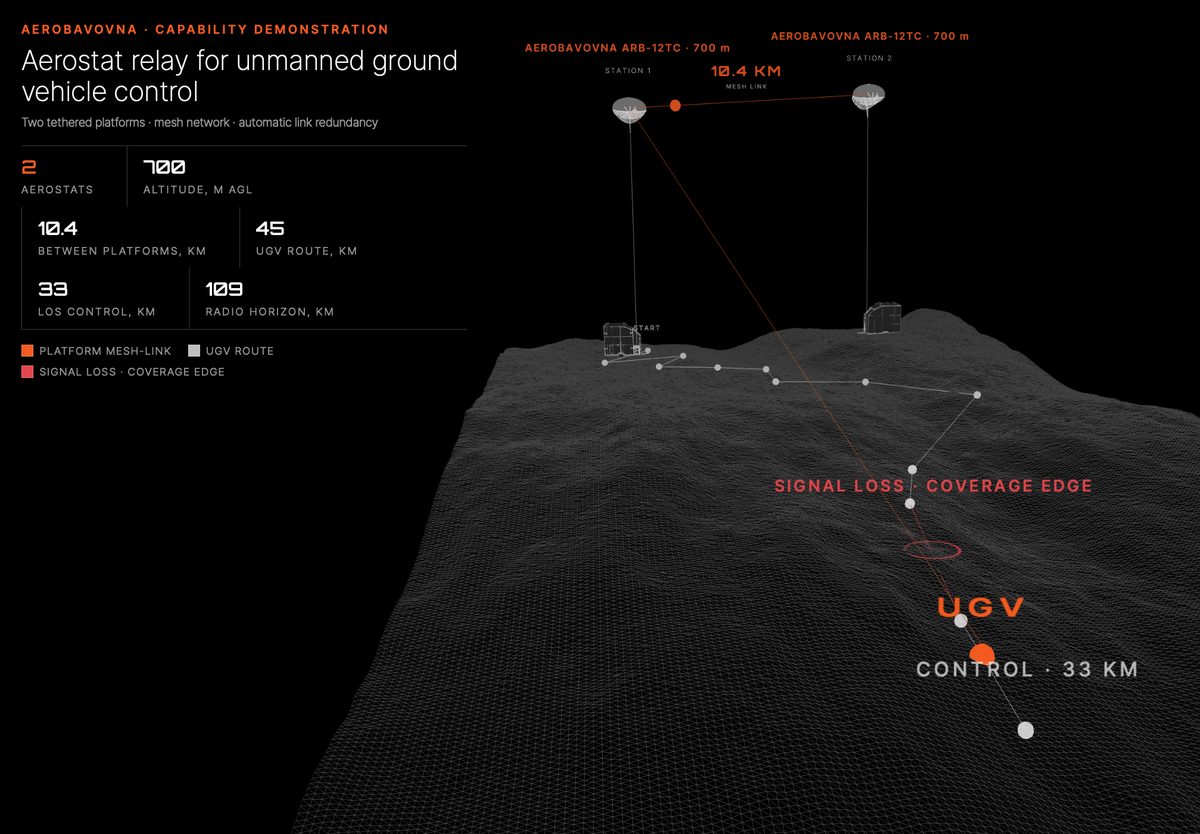
We tested it. Two tethered aerostats carrying SILVUS mesh radios as the payload, holding station at 700 metres above ground. The two platforms mesh to each other across roughly 10 kilometres, and between them they hold a control link over a 45-kilometre UGV route — about 33 kilometres of continuous line-of-sight control, against a radio horizon of some 109 kilometres from that altitude. When the robot rolls behind terrain and drops off one platform, the mesh hands it to the other. No relay drone to refuel, no satellite in the loop — the same SILVUS radio the heavy platforms already carry, simply lifted to where it reaches.
Schematic capability visualization — terrain illustrative, distances representative. Drag to orbit, wheel to zoom. Open full-screen ↗
Who to watch next
The interesting movement now is in the communications layer itself, not the vehicles. Two Ukrainian companies are worth tracking. Sine Engineering (Lviv) builds jam-resistant, GPS-independent data links and frequency-hopping mesh that already run on more than fifty drone makers' platforms. Bravo Dynamics is building Phantom, a ground-based mesh designed to hold UGV command links under electronic warfare — reportedly out to 80 km, without an airborne relay — and has started integrating with UGV manufacturers including Roboneers. They are attacking the same constraint from opposite directions: distributed ground mesh on one side, elevated persistent relay on the other. Both exist for the same reason — the control link, not the robot, is what decides whether the fleet works.
Starlink solved reach. Keeping the rest of the stack — the control radio, the mesh, the fibre — actually connected to a robot several kilometres out is the problem worth building for.
One closing note, on the picture itself. The 3D scene above was not built by a design team — it was generated from the raw test report by AI, in minutes: terrain, platforms, tethers, route, telemetry overlay and all. Turning a field test into a readable, interactive 3D visualization used to take days of work. Now it takes a prompt. The tooling around defence engineering is accelerating about as fast as the hardware it documents — and that is worth being excited about.
Aerobavovna designs and manufactures military-grade aerostat systems for elevated connectivity — communications relay, ELINT, and antenna elevation — deployed with the Armed Forces of Ukraine.
FAQ
How many ground robots has Ukraine contracted for 2026?
More than 22,000 — nearly double all of 2025 — with a target heading toward 50,000.
What do Ukrainian ground robots use for connectivity?
Almost all carry Starlink (~99% per operators), but the codified logistics fleet names Starlink on only about 7 in 10 configurations. A single satellite link is a single point of failure in contested EW conditions.