Tracking the russian starlink (rassvet) satellite constellation over Ukraine
Rassvet is Bureau 1440's Starlink-analogue LEO constellation. We built a tool that forecasts and maps its windows of geometric visibility over Ukraine, up to 72 hours ahead — geometry, not traffic.

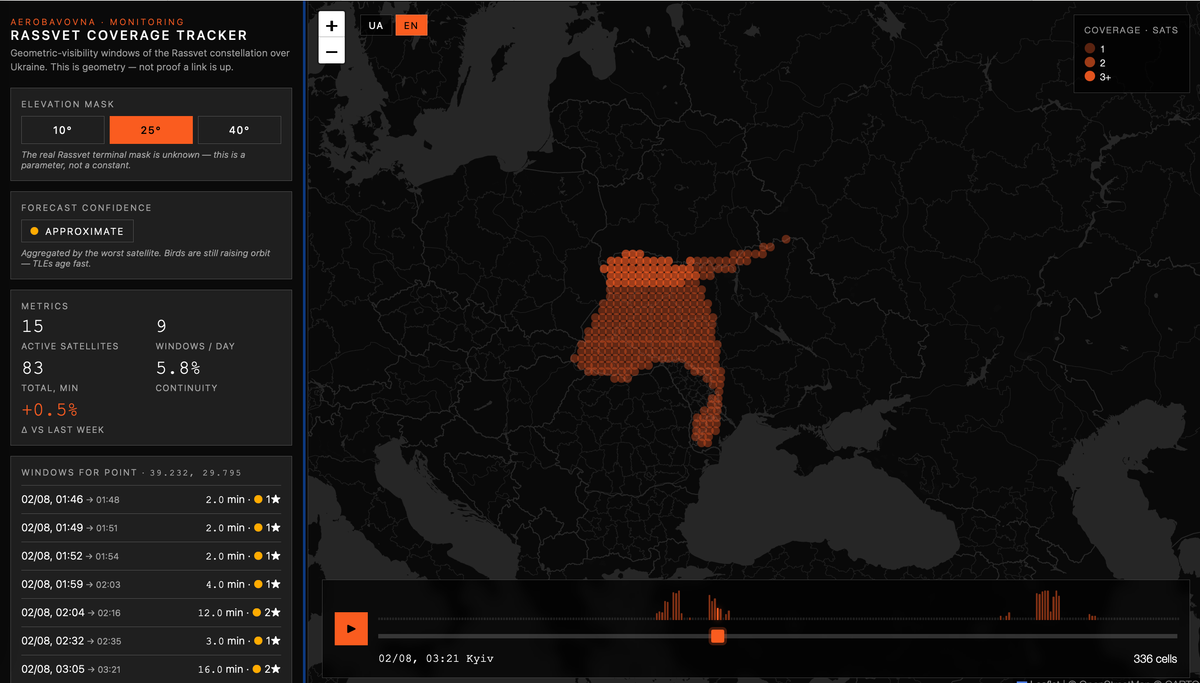
Rassvet is a low-Earth-orbit satellite constellation being built by the Russian company Bureau 1440 as a domestic analogue of Starlink — sovereign high-speed broadband delivered from space. Deployment began in 2026: a first batch of 16 production satellites in March and a second batch of 16 (Rassvet-3) on 19 July, alongside a handful of earlier experimental Rassvet-1 and Rassvet-2 craft. Around 15 objects from the latest group are currently catalogued in low orbit at roughly 500 km. Bureau 1440's stated roadmap targets on the order of 292 satellites by 2030, with commercial service planned from 2027.
At today's numbers the constellation is sparse. Over any given point in Ukraine it currently provides only short, intermittent windows of geometric visibility — on the order of a couple of passes per day — rather than continuous coverage. That changes as more satellites reach orbit.
We built a tool that forecasts and visualises these windows. It resolves the live satellite catalogue from public tracking data (Celestrak), propagates the orbits with standard SGP4, and shows — up to 72 hours ahead — when and where over Ukraine the constellation is geometrically visible above the horizon. The interface has a map heat-layer of how many satellites are simultaneously in view per location, a time animation with a coverage timeline, an elevation-mask selector (10/25/40°), a forecast-confidence indicator, and per-point visibility windows.
One caveat matters. This is geometry, not traffic: a "window" means at least one satellite is above the assumed terminal elevation mask for a point — it does not mean a link is actually working. Payload status, ground gateways, capacity and beam allocation are unknown to us, and the real terminal mask is a parameter, not a measured constant. The data refreshes every six hours.
Space-based broadband is, in effect, the highest form of elevated connectivity — the same principle we work on, taken to orbit. As Rassvet grows, persistent connectivity over the battlefield becomes a Russian capability with direct implications for the front. We will keep tracking the constellation and updating what we know about Russian capabilities here.