The Starlink Gap: Why Every Army Needs a Layer Between Satellites and the Ground
Starlink transformed battlefield communications. And then, in certain places and situations, it stopped working. Here is why — and what fills the gap.


Key takeaways
TL;DR. Starlink transformed battlefield communications, then hit limits exactly where comms matter most — jamming and EW, denied or degraded availability, and reliance on a single commercial constellation that has gone dark globally at least once. That is the Starlink gap: not a failure of satellites, but the case for a resilient middle layer between them and the ground.
- Limits cluster around three things: availability, electronic warfare / jamming, and single-provider dependence
- One commercial constellation is a single point of failure — a global outage has occurred at least once
- The gap shows up exactly where communications matter most — near the line of contact
- The fix is a layered “middle” link between satellites and the ground — not replacing Starlink
Starlink transformed battlefield communications in Ukraine. Tens of thousands of terminals, near-instant connectivity, decentralized command. It worked.
And then, in certain places and situations, it stopped working — or became a liability rather than an asset. Not because the technology failed. Because the battlefield placed conditions around it that the technology was never designed to handle.
That is the Starlink gap: not an indictment of satellite connectivity, but a recognition that it has limits — and that those limits tend to show up exactly where communications matter most.
Why Starlink Is Unavailable (The Short Version)
There are several reasons a unit may find itself without satellite connectivity, and they fall into roughly three categories.
Tactical exposure — thermal, not radio. Starlink terminals work fine at depth. The risk near the line of contact is not primarily about radio-frequency detection — locating an active terminal via RF intelligence is technically difficult. The real vulnerability is simpler: a working Starlink terminal generates significant heat. Any drone equipped with a thermal camera can identify it. In an environment saturated with reconnaissance UAVs, a hot terminal on the ground is a visible target. That is a different threat model than EW, but in many ways a more immediate one — and it is enough to make commanders weigh the value of connectivity against the exposure it creates.
State-level denial. The more documented threat to Starlink is not battlefield jamming but deliberate government action. Russia has not demonstrated a reliable capability to suppress Starlink across Ukrainian territory — the network has remained largely functional throughout the war. A clearer precedent came in January 2026, when Iranian authorities imposed a nationwide internet blackout during civil unrest. Using a combination of RF jamming, GPS spoofing, and equipment seizures — backed by criminal penalties of up to ten years for terminal possession — they degraded Starlink traffic to over 80% packet loss by the end of the first day. It became the longest nationwide internet shutdown ever recorded. The lesson is not that Starlink is easy to jam. The lesson is that a sufficiently motivated state, with the right combination of technical and legal tools, can make it functionally unavailable within its territory.
Regulatory and access restrictions. Starlink's availability is controlled by SpaceX's operational decisions, export licenses, and government agreements. The network is geofenced by country — a terminal authorized for Ukraine does not function in Russia. When Ukrainian forces crossed into Kursk Oblast in August 2024, they discovered this constraint in real time: units that had operated on Starlink connectivity for months found themselves without a link the moment they crossed the border. The communication gap was immediate and operationally significant — troops reported difficulty coordinating positions and distinguishing units in unfamiliar terrain without the network they had built their procedures around. Part of the solution came from elevated relay platforms deployed behind the line of contact, on the Ukrainian side, extending radio range across the border to units that had lost satellite access. The terminals themselves could not be moved forward. The connectivity could be.
Single-provider reliability. In August 2025, a global Starlink outage left two dozen U.S. Navy unmanned surface vessels drifting without control off the California coast for nearly an hour. The incident — revealed in internal Pentagon reports released in April 2026 — was not an edge case. Similar connectivity failures had disrupted Navy drone tests as early as April 2025, when the network struggled to handle the data load of multiple autonomous vehicles operating in formation. The disclosure triggered a debate in Congress about the military's "de facto monopoly" dependence on a single commercial provider for critical command-and-control links. The Pentagon's own conclusion: redundancy is not optional.
The specific reason varies by unit and sector. The outcome is consistent: there are conditions — tactical, regulatory, technical — under which satellite connectivity is unavailable or constrained, precisely at the edge where it would matter most. And when that happens, there is often nothing between the satellite and a short-range radio.
The Real Gap Is Architectural
Here is the problem stated precisely: modern military communications have two layers that work reasonably well, and a missing middle.
Satellite (high layer): Global coverage, high bandwidth, latency in the range of 20–60ms for LEO systems. Excellent for logistics, rear-area coordination, and long-haul data. Subject to EW degradation and exposure constraints in specific contested zones near the contact line.
Ground infrastructure (low layer): Short-range radios, mesh networks, fiber where it exists. Reliable inside their range envelope, but range-limited by terrain and earth's curvature. A soldier in a trench can talk to the next position. Coordinating across 40 kilometers of broken terrain is a different problem.
The missing middle: An elevated relay layer — something between the satellite and the ground — that extends radio range without the signature problems of a satellite terminal, without the range limitations of ground radio, and without requiring a pilot, fuel, or constant maintenance.
This is not a new concept. Militaries have understood the value of elevated communications for decades. What has changed is the cost, the deployment time, and the threat environment that now makes the missing middle layer tactically urgent.
What Fills the Gap
The solution space for elevated connectivity is narrow. You need something that can get a communications payload to altitude, hold it there persistently, survive wind and weather, and ideally not cost more than the payload it carries.
Drones can carry relay payloads, but their endurance is measured in hours, not days. Continuous coverage requires constant rotation of aircraft, crews, and logistics. In a sustained operation, this becomes expensive and operationally complex.
HAPS (High Altitude Pseudo-Satellites) — stratospheric platforms operating at 18–22km — offer wide coverage but are still nascent technology, expensive to develop, and difficult to operate tactically.
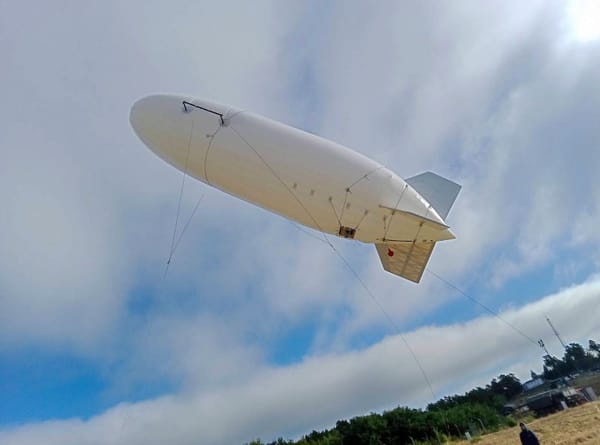
Tethered aerostats occupy a specific and practical niche: a lighter-than-air platform, tethered to the ground, capable of lifting a communications payload to 1,000 meters of altitude and holding it there for days or weeks at a time. No fuel. No pilot. No rotation schedule. Power and data travel up the tether. The platform stays up.
At 1,000 meters of altitude, geometric line-of-sight extends approximately 130 kilometers to the horizon — but that is a ceiling, not a guarantee. Modern tactical data radios — Silvus, Persistent Systems, DTC, Harris, Motorola — typically achieve 30 to 80 kilometers of working range when transmitting real data payloads. On the ground, that range is further compressed by terrain, buildings, and vegetation. An aerostat does not change the radio's physics. What it does is remove the terrain masking: a payload elevated to altitude achieves its full specified range consistently, across broken ground, in all directions simultaneously. The practical result is a relay node that covers a brigade-sized sector from a single tether point — with no orbit, no uplink to space, and no latency penalty beyond the radio link itself.
Critically: the aerostat itself does not transmit to space. The RF signature profile is that of the payload radio, not a satellite uplink. The tactical exposure calculus is different.
The Middle Layer as Doctrine
There is also a scenario that belongs in any serious discussion of satellite dependency, even if it sits at the far end of the probability distribution. In a high-intensity conflict between peer adversaries, low Earth orbit itself becomes a target. Anti-satellite weapons — kinetic interceptors, directed energy, co-orbital systems — have been tested by Russia, China, and the United States. The destruction of even a modest number of satellites at LEO altitudes generates debris fields that travel at orbital velocity, colliding with other satellites and producing exponentially more debris. This cascade effect, known as the Kessler Syndrome, can render entire orbital shells unusable for decades. A conflict that begins with ASAT strikes on military communications constellations does not need to be a global nuclear exchange to produce an outcome where LEO-dependent infrastructure — including Starlink — is functionally gone for a generation. Elevated terrestrial platforms do not orbit. They are not affected by orbital debris. In a post-Kessler environment, they may be the only persistent connectivity layer that still works.
The Starlink gap is a symptom of a larger architectural problem: the assumption that satellite connectivity will be available, accessible, and reliable wherever it is needed. That assumption has not held in Ukraine's contested front-line zones. It did not hold for the U.S. Navy off California in August 2025. It is unlikely to hold in future high-intensity conflicts where electromagnetic warfare is a first-order capability on both sides — and where a single outage can leave dozens of autonomous systems without a command link.
Armies that build their communications architecture around a two-layer model — satellite for the rear, ground radio for the immediate tactical environment — are leaving a gap in the middle. Units operating at range, coordinating across terrain, or working in EW-contested zones fall into that gap.
Filling it requires persistent elevated platforms. Not as a replacement for Starlink — satellite connectivity remains essential for the rear and for certain tactical applications. But as an intermediate layer that extends range, reduces satellite dependency at the edge, and survives in the electromagnetic environment that modern warfare actually produces.
The technology exists. The platforms are deployable in minutes. The operational case is being proven in combat, now.
The question is whether force structure catches up to the architecture that the battlefield is demanding.
Aerobavovna designs and manufactures military-grade aerostat systems for elevated connectivity — communications relay, ELINT, and antenna elevation — deployed with the Armed Forces of Ukraine.
FAQ
Why isn't Starlink enough on its own?
It can be jammed, denied or degraded, and it depends on a single commercial constellation that has gone dark globally at least once — so units need a second, independent layer.
What is the “Starlink gap”?
The gap where satellite connectivity becomes unavailable or unreliable — filled by an elevated middle layer, such as aerostat-borne relays between satellites and the ground.