Small airships for military


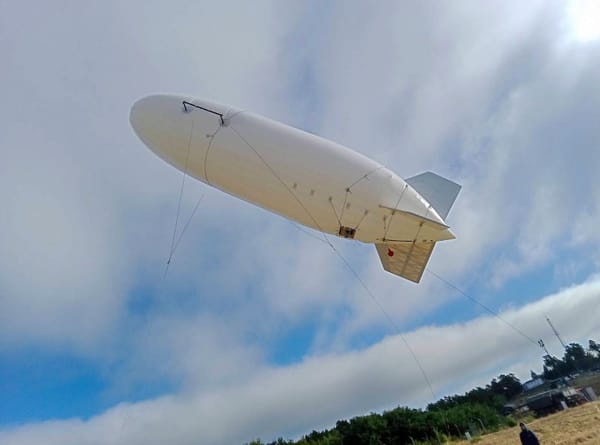
A new class of aerial platform is emerging: small, autonomous, lighter-than-air drones. Not the giant rigid airships of the 1930s — purpose-built, technology-dense machines that can stay aloft for hours, carry sensor payloads, and operate silently in environments where conventional drones struggle.
Three converging technologies are making this possible now: lightweight materials that make small envelopes structurally viable; hydrogen PEM fuel cells that matured post-2020, providing power and ballast management simultaneously; and new regulatory frameworks like the FAA's Part 108 rule (2025/2026) that created standardized BVLOS operating frameworks — replacing the previous system of per-flight waivers with something operators can actually build businesses around.
The core physics advantage is straightforward. A lighter-than-air drone uses buoyancy to stay aloft, not thrust. The same energy budget that powers a multirotor for 30 minutes keeps a small airship flying for 10 to 12 hours. Beyond endurance, they're quieter, more stable for sensitive payloads, safer in the event of power loss, and permitted to fly in airspace categories where other drones cannot operate.
Who's Building This
Kelluu (Finland) is the most operationally credible small airship in the field. Their 11–12 meter hydrogen-powered platform carries 5–6 kg, stays aloft 12 hours, and has completed five NATO deployments. Selected for NATO's DIANA innovation accelerator in 2024, tested in Arctic conditions down to -30°C, designed for GNSS-denied environments. They hold a patent on a variable-shape hull that adjusts geometry in flight — shorter and wider for lift, longer and narrower for speed. Maximum airspeed: 53 km/h.
HyLight (France) — the HyLighter carries up to 10 kg of sensors over 350 km in a single 10-hour flight. Hydrogen-powered. Cruise speed 35 km/h. Currently deployed for infrastructure inspection in Europe; no defense contracts disclosed.
Cloudline (South Africa) — 18.2m solar-powered autonomous airship, production-ready as of early 2026. Carries ~20 kg of payload, range 200–400 km at 40 km/h cruise, effectively unlimited endurance in daylight. Designed for logistics and monitoring in infrastructure-poor environments.
Hemeria (France) — a different scale entirely. An established French defense contractor with platforms carrying up to 250 kg, configured for EO/IR, radar, comms relay, and SIGINT/COMINT. Partner of France's DGA defense procurement agency. Not a "tiny blimp" — a medium airship with real defense pedigree, and a signal of where the technology needs to go for full battlefield relevance.
H-Aero (Germany) — 3 kg payload, 10 km/h wind tolerance. Useful for confined indoor inspection; limited outdoor applicability.
Roboloon (Germany) — 8m autonomous airship, 1.5 kg payload, 25–30 km/h max airspeed. Excellent close-in maneuverability for infrastructure inspection. Civilian only.
Windreiter (Germany) — spans racing airships to autonomous inspection platforms. Notable for their CERN deployment: an airship operating autonomously through radiation-filled underground caverns where no other platform could safely go.
The Size Problem
To understand what these platforms can and can't do, the full spectrum is instructive.
The Goodyear Blimp (75m) tops out at 117 km/h. China's AS700 "Xiangyun" manned airship (50m), which entered commercial operation in late 2025, reaches 100 km/h with a 700 km range. Both fly reliably in real weather. This isn't surprising — volume scales with the cube of linear dimensions while drag scales only with the square. Bigger is disproportionately better.
The current state of the art for small platforms:
| Platform | Length | Payload | Wind tolerance |
|---|---|---|---|
| H-Aero / Roboloon | 3–8m | 1.5–3 kg | 10–30 km/h |
| Kelluu | 11–12m | 5–6 kg | ~40 km/h |
| Cloudline | 18.2m | ~20 kg | ~40 km/h |
| Hemeria | ~30m+ | up to 250 kg | operational |
| AS700 Xiangyun | 50m | 9 passengers | 100 km/h |
| Goodyear Blimp | 75m | 12 passengers | 117 km/h |
The pattern is clear. Below roughly 15 meters, wind tolerance drops sharply and payload becomes marginal. The 8–12 meter platforms dominating current media coverage are operating near the lower boundary of what physics permits for outdoor autonomous missions.
The Defense Gap
For actual defense applications, two requirements collide with current small airship capabilities.
Wind. Field conditions routinely produce 30–60 km/h winds in open terrain. Kelluu is the only small airship that approaches this range, and at ~40 km/h effective operational wind it's still on the margin. HyLight's ~20–25 km/h effective limit is a gentle wind. Most of these platforms ground themselves precisely when field operations intensify.
Payload + power budget. Meaningful defense sensors — comms relay equipment, ELINT receivers, direction-finding antennas — start at 5–10 kg and draw continuous power. The two requirements compete directly: more payload requires a larger envelope, more drag, more propulsion, and less wind penetration. Most small airships trade payload for endurance in favorable conditions. When conditions worsen, the trade collapses.
The platforms that come closest to defense-viable are not "tiny." Cloudline's 20 kg payload comes on an 18-meter airship. Hemeria's defense-grade platforms are larger still. The physics assert themselves at every scale reduction.
This isn't a criticism of the companies working in this space — it's an engineering reality that will take years to fully resolve. The progress is genuine. But the gap between current small airship demonstrations and what a defense operator needs in the field today remains significant.
The Warfare Context
Ukraine has become the world's first drone war at scale, and the operational lesson is clear: persistent elevated presence, over time, in degraded conditions, shapes the information environment that everything else depends on.
Free-flying autonomous airships occupy a real niche as the technology matures — lower cost than fixed-wing UAVs, longer endurance than multirotors, quieter than either, operable over urban areas where other platforms cannot go. NATO's investment in Kelluu through DIANA signals the alliance recognizes this. The question is timing and conditions.
Where We Stand
At Aerobavovna, we've been deploying tethered aerostat systems to Ukrainian military units since before this space attracted widespread attention. We know from field experience what elevated connectivity means when communications fail, when drones are jammed, when the enemy controls the electromagnetic spectrum.
The emergence of autonomous free-flying airships is a development we follow with genuine interest. But for missions requiring operation above 40 km/h wind, payloads above 10 kg, and endurance measured in days — the current generation of free-flying small airships isn't there yet.
The new airship era is coming. For now, it complements rather than replaces platforms built for the conditions that actually exist on the battlefield.
Aerobavovna designs and manufactures tethered aerostat systems for elevated connectivity — communications relay, electronic intelligence, and antenna elevation for military operations. Deployed to Ukrainian Armed Forces, Special Operations Forces, Intelligence Services, Border Guard, and National Guard. Learn more →