Tethered Drones vs. Small Aerostats: A Technical Comparison

The Rise of Tethered Aerial Platforms
Over the past three years, tethered aerial platforms have moved from niche research projects into active military and public safety procurement. The driver is straightforward: free-flying drones are limited by battery life. A multirotor that carries a useful payload — a communications radio, a surveillance camera, an EW sensor — can stay airborne for 20 to 40 minutes before it must land and recharge. For persistent operations, that is operationally unacceptable.
The tether solves the energy problem by connecting the aircraft to a ground power source via a cable, enabling flights measured in hours or days rather than minutes. In parallel, the tether provides a secure, jam-resistant data link — a significant advantage in contested electromagnetic environments where Wi-Fi and radio control links are actively jammed.
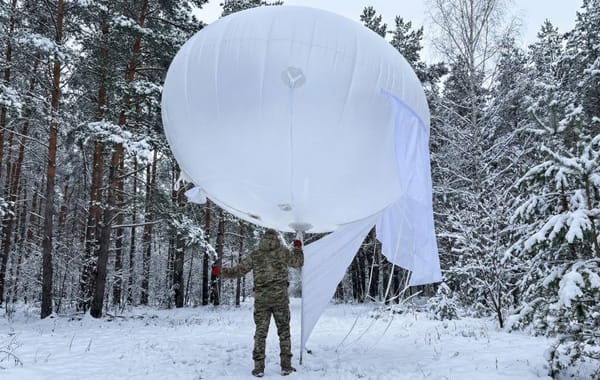
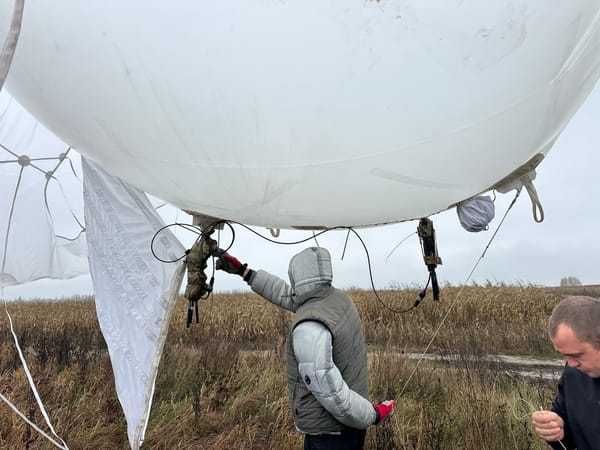
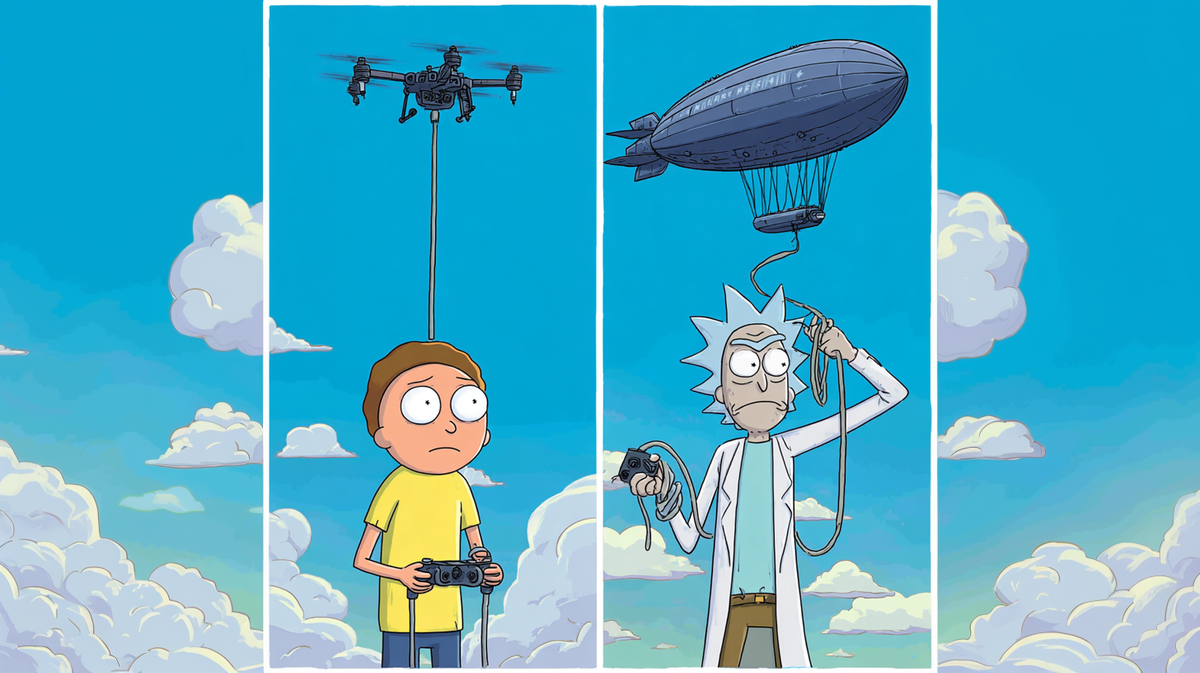
Two distinct technology families have emerged to fill this persistent-elevation role: tethered drones(multirotor or fixed-wing aircraft powered through the tether) and tethered aerostats (lighter-than-air envelopes lifted by helium and moored to a ground station). Both solve the endurance problem, but they do so with different physics — and those differences show up clearly in payload capacity, operating altitude, and operational cost.
Major Tethered Drone Manufacturers
The global tethered drone market is dominated by a handful of companies, each targeting a slightly different segment of the market.
Elistair (France) is the most widely deployed tethered drone manufacturer, with systems fielded in over 70 countries. Their flagship product, the Orion 2.2 TE, is an octorotor designed for persistent ISR and communications relay. It carries up to 5 kg of payload to 90 meters altitude and has completed a validated 50-hour continuous flight. The system is powered and data-linked through Elistair's Safe-T 2 ground station, which delivers up to 2,200 W through a micro-tether. The Orion is modular — it can carry a dual EO/IR camera block or a communications relay payload without changing the airframe.
Hoverfly Technologies (United States) focuses on military and public safety customers. Their Sentryplatform has been sold to the U.S. Army in quantity (over 500 units) primarily for use as a variable-height antenna — lifting tactical radios to 60 meters (200 ft) to dramatically extend the range of ground communications networks. The Sentry carries up to approximately 3.6 kg of payload and, like all tethered systems, can remain airborne indefinitely when connected to grid or generator power. Hoverfly raised a $20 M Series B in late 2025 and is expanding into airborne counter-UAS and electronic warfare payloads.
Fotokite (Switzerland / United States) takes a different approach. Their Sigma platform is designed for fast autonomous deployment by first responders — it launches, hovers, and lands with a single button press and requires no pilot. The Sigma reaches 45 meters altitude and can fly for 24 continuous hours connected to a vehicle's power supply. The airframe itself weighs 1.3 kg, and the primary payload is an integrated multi-sensor camera (thermal, wide-angle, and 16x optical zoom). Fotokite targets fire departments and emergency management agencies rather than military customers, though their defense-variant Gamma is under development.
Huless (Ukraine) is one of the few domestic Ukrainian manufacturers of tethered drone systems. Their Highline-T is designed specifically for military communications relay in GPS-denied, EW-contested environments. Power, control, and data are delivered through a 170-meter tether cable, with a 7-minute onboard battery providing emergency backup. The system lifts payloads of up to 5 kg to 150 meters altitude, delivers data throughput of up to 100 Mbps, and deploys in approximately 2.5 minutes. Notably, the Highline-T does not emit any radio signal — making it electromagnetically invisible to enemy detection — and operates under full GPS denial using optical stabilization. Wind resistance is rated to 10 m/s. The system includes a one-axis antenna suspension for relay equipment, an onboard course camera, and optional EO payloads. Huless raised over $1 million in early 2025 through private investors and a Brave1 defense cluster grant.
150 m500 m1,000 maltitude scaleGROUND STATION150 mTethered Drone↕ Max altitude: 150 m⚖ Payload: 3–5 kg⏱ Endurance: 4–50 h⚡ Needs continuous powerTethered Dronerotary-wing · electrically poweredWINCH STATIONAB-20up to 1,000 mTethered Aerostat↕ Max altitude: 1,000 m⚖ Payload: 6–25 kg⏱ Endurance: days–weeks⚡ No power (helium lift)Tethered Aerostatlighter-than-air · helium buoyancyFigure 1. Altitude comparison — tethered drone vs. tethered aerostat (proportional scale)
Side-by-Side Specification Comparison
| Platform | Manufacturer | Max Payload | Max Altitude | Endurance | Power Source |
|---|---|---|---|---|---|
| Orion 2.2 TE | Elistair 🇫🇷 | 5 kg | 90 m | 50 h+ | Ground (tether) |
| Sentry | Hoverfly Technologies 🇺🇸 | ~3.6 kg | 60 m | Unlimited* | Ground (tether) |
| Sigma | Fotokite 🇨🇭 | ~1 kg | 45 m | 24 h | Vehicle (tether) |
| Highline-T | Huless 🇺🇦 | 5 kg | 150 m | 4 h | Ground (tether) |
| AB12DMR | Aerobavovna 🇺🇦 | 6 kg | up to 1,000 m | Days–weeks | Helium (none) |
| AB20DSN | Aerobavovna 🇺🇦 | 10 kg | up to 1,000 m | Days–weeks | Helium (none) |
* Unlimited endurance subject to ground power availability and maintenance cycles.
Where the Two Technologies Diverge
Payload capacity. Tethered multirotors are constrained by the physics of rotary-wing flight — lift is produced by spinning rotors, which consume power proportional to the weight they lift. Even with unlimited ground power through the tether, the most capable systems top out at 4–5 kg of useful payload. Aerostats generate lift through buoyancy: a 40 m³ helium envelope displaces roughly 44 kg of air, providing lift with no power consumption at all. That is why the AB40PSN carries 15 kg of payload, and the company's newest platform carries 25–30 kg — figures that would require a large, power-hungry multirotor to match.
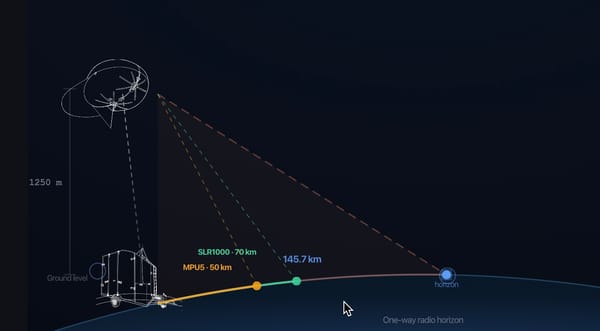
Altitude. Current commercial tethered drones operate at 45–100 meters, constrained partly by tether weight and partly by power loss over longer cable runs. Aerostats can operate at up to 1,000 meters depending on tether length — an order of magnitude higher than most tethered multirotors. That altitude gap is not cosmetic: line-of-sight communications range scales with the square root of antenna height, so a payload at 1,000 m extends radio coverage dramatically further than the same payload at 90 m.
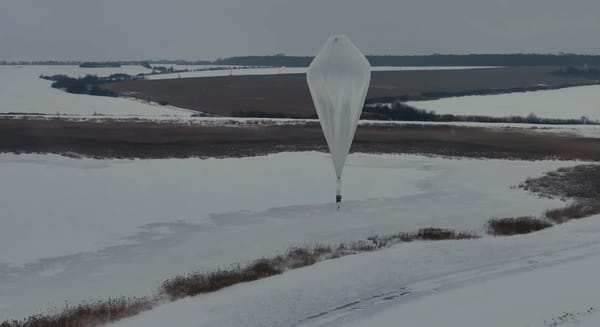
Endurance. Tethered drones connected to ground power achieve effectively unlimited flight time in theory, but in practice face limitations from motor wear, electronic stress, and the logistics of maintaining continuous power. Aerostats require no power to stay aloft — helium provides lift passively. An aerostat can remain on station for several days to several weeks depending on envelope size and helium retention rate.
Mobility and setup time. This is where tethered drones hold a genuine advantage. The Fotokite Sigma deploys autonomously in under a minute. Hoverfly's Sentry can be operational in a few minutes by a small crew. Small aerostats require inflation time — the AB12DMR is designed for rapid deployment and can be transported pre-inflated, taking approximately 7 minutes to station. Larger aerostats require 30+ minutes and a team of operators. For highly mobile tactical units that need to reposition frequently, the setup overhead of an aerostat is a real operational consideration.
Wind tolerance. Tethered drones are susceptible to wind load on their rotors and airframe. Most commercial systems are rated to around 40–50 km/h. Aerostats face wind drag on the envelope but with proper stabilization systems can operate in winds up to 90 km/h.
Cost Analysis
Cost is where the two technology families diverge most sharply over a full operational lifecycle — not just at point of purchase.
Acquisition cost. Entry-level tethered drone systems from established Western manufacturers (Elistair, Hoverfly) typically start at $20,000–$50,000 USD for the air vehicle and ground station, before payload integration. Full military-configured systems with EO/IR or comms relay payloads commonly exceed $80,000–$150,000. Military-grade aerostats from Aerobavovna start at approximately $20,000 USD for the smallest complex, with larger systems scaling by envelope volume and payload.
Operating cost. This is where the two platforms diverge most. Tethered drones are mechanically complex — spinning rotors accumulate wear hours, motors require scheduled replacement, and electronic speed controllers and power delivery systems must be maintained continuously. A system running 24/7 for 30 days accumulates 720 motor-hours. Aerostats have no moving parts in the lift system. The envelope, tether, and winch require periodic inspection, but there are no rotating components subject to fatigue failure. Helium top-off is the primary recurring cost.
Power consumption. Tethered drones draw continuous electrical power through the tether — the Elistair Safe-T 2 delivers up to 2,200 W to keep the Orion airborne. Running a generator at that load for 30 days consumes significant fuel and introduces supply chain dependency in the field. An aerostat at altitude consumes no power for lift. Any onboard power requirement covers only the payload electronics.
| Cost Factor | Tethered Drone | Small Aerostat |
|---|---|---|
| Entry-level system price | $20,000–$50,000+ | From ~$20,000 |
| Continuous power draw | ~1,000–2,200 W | ~0 W (lift only) |
| Primary recurring cost | Fuel, motor replacement, spare parts | Helium top-off, envelope inspection |
| 30-day operating cost (est.) | High (generator fuel + maintenance) | Low (helium refill only) |
| Failure mode cost | Motor failure = mission abort; part lead time | Slow descent preserves payload on damage |
For short-duration missions measured in hours or a few days, the acquisition cost is the dominant factor and the two platforms are broadly comparable. For persistent operations lasting weeks — border monitoring, forward operating base protection, sustained communications relay — the total cost of ownership of an aerostat is substantially lower, primarily because it consumes no power for lift and has no rotating parts to replace.
Conclusion
Tethered drones and aerostats occupy overlapping but not identical niches. Tethered drones excel in rapid-deploy scenarios where a small team needs aerial awareness or a communications node within minutes, without pre-positioned helium supply. They are best suited for payloads under 5 kg at altitudes below 100 meters.
Aerostats become the more capable platform when the requirement is for heavier payloads, greater altitude (up to 1,000 m versus 45–100 m for tethered drones), multi-day endurance without a continuous power supply, and lower total operating cost over extended missions. In environments where electronic warfare is active and communications range is a limiting factor in operations, the physics of buoyancy-based flight offer advantages that rotor-based systems cannot yet match at comparable cost.
As battlefield requirements evolve, both technologies are likely to coexist — each filling a role the other cannot serve as efficiently.